



Virto Atomic Architecture™
What is Virto Atomic Architecture™?
Virto Atomic Architecture™ is Virto Commerce’s proprietary implementation of composable commerce architecture. It lets you replace one capability while the business keeps trading. The Commerce Innovation Platform, a managed composable platform, is built on it.
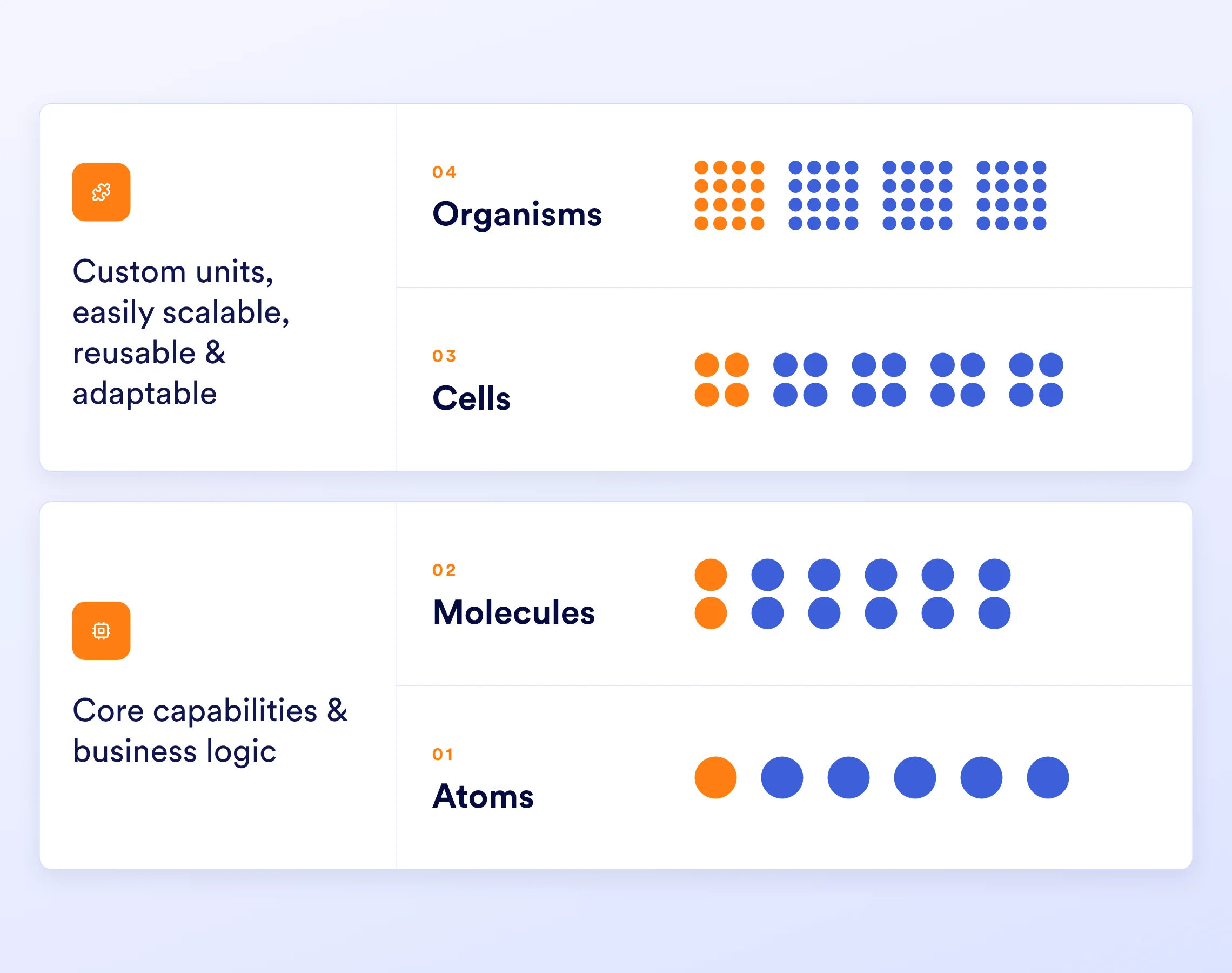
Capabilities are organized into four levels of granularity: atoms, molecules, cells and organisms. You choose which capabilities to assemble and where each component runs, on Virto Cloud or on your own infrastructure. This structure is what makes the platform composable, API-first, and headless.
How Is Virto Atomic Architecture™ Built?
The four levels come from atomic design, where small reusable parts build up into larger ones. Modules communicate with each other through well-defined APIs, so you can change one capability without affecting the rest.

Atoms
Core principles and design patterns that every module follows. They are the smallest building blocks, and every level above is built on them.
Examples: Modularity, API-first, Security, Caching, Events.
Molecules
Two or more atoms combined into a module with a single responsibility. Molecules communicate with each other through APIs. Virto Commerce ships 100+ pre-built modules at this level.

Cells
Several molecules combined into a business-ready bundle that covers a complete scenario.
Examples: Digital Catalog, Order Management, Vendor Management.

Organisms
Several cells combined into a complete commerce product that your buyers, sellers, and partners use.
Examples: Virto B2B Commerce Platform, Virto Portal, Virto Marketplace
How Do the Parts of Virto Atomic Architecture™ Fit Together?
What Do You Gain from Virto Atomic Architecture™?
Fast Solution Development
Create commerce solutions by reusing existing modules, adding new ones, or adapting modules built by the Virto Commerce team and solution partners.
Adapts as You Grow
Atomic Architecture™ lets you add a brand, a market or a sales channel with its own experience, while what already runs stays in place.
Reduced Time-to-Market
Launch and test new ecommerce scenarios on pre-configured modules, and respond sooner when customer demands change.
Higher Team Productivity
One structure across all modules, plus dotnet new module templates and the Virto Commerce CLI (vc-build), means your developers learn the platform once and spend less time on implementation and upkeep.
No Vendor Lock-in
Swap a capability for a third-party service or your own module, and see how the platform works in its source-available code. You aren’t tied to us or to one integrator. Read how this differs from MACH.
Predictable Ownership Costs
Deploy only the components you need. Extensions sit alongside the core rather than changing it, so upgrade costs don’t grow with each customization, and the platform evolves without a replatforming project.
Virto Architectural Guidelines
A detailed look at how the Commerce Innovation Platform is designed, extended, and deployed.
Replace One Capability While the Business Keeps Trading
Each capability can be separated, replaced, upgraded or retired on its own once the platform is live. Capabilities communicate through defined contracts (APIs, events, data models), not shared internals, applying microservice principles within a single extensible engine.
Composable describes what you can assemble before go-live.
Decomposable describes what you can take out afterwards, once the platform carries revenue.
A shared SaaS core can’t be taken apart, and with an assembled stack, keeping the parts working together is your team’s job.
Want to learn more about the Commerce Innovation Platform?
Talk to our team

Your Questions, Answered
They stay where they are. Customizations attach to modules through extension points rather than by editing the modules themselves, so a platform update doesn’t affect them, and a release with breaking changes includes a migration guide. Notions Marketing, for example, runs 20+ targeted module extensions across orders, search, pricing, customer and inventory, all kept separate from the core so the platform stays upgradeable.
No. It applies microservice principles, with separate capabilities that have their own data, logic and APIs, inside one extensible platform rather than as separately deployed services. You get independent modules without having to run and coordinate dozens of services.
Yes. Custom modules follow the same structure as Virto Commerce’s own. They declare what they depend on, extend the platform through published extension points and appear in the admin interface, without changing the platform’s code.
No. The base installation is minimal, and you install only the modules your solution needs, then add more later as the business grows.
Stable bundles are released about every three months, and you choose when to switch to one. A release that breaks compatibility comes with a migration guide, and every time the platform starts, it checks that your entire module set, including custom modules, still fits together. Teams that want new features sooner can use edge releases instead.
AI is part of the architecture, not an add-on. It works inside the catalog, search, orders and workflows, on the same data and business rules as every other channel, and you choose the models and agents. Commerce capabilities are exposed through defined APIs, so you can introduce AI without rebuilding the platform. External agents connect through open standards: UCP (Universal Commerce Protocol) for buying and onX (Order Network eXchange) for order operations. You do not need a separate integration for each agent, and your store stays the merchant of record. See how AI works in Virto Commerce.