


The Managed Composable Commerce Platform
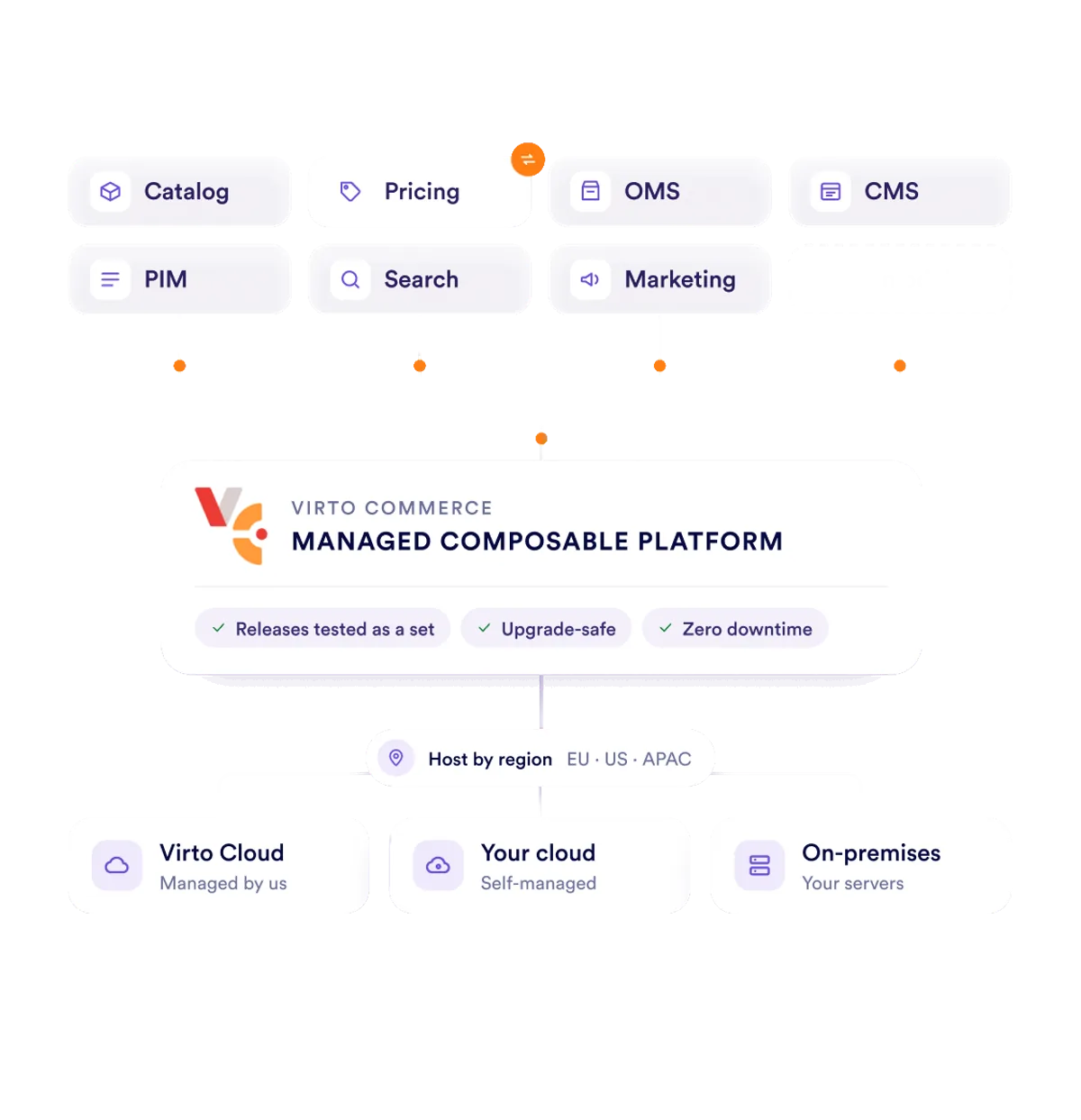 Go global without losing local touch. Assemble what you need, change it deeply, run it where you need it, on a platform that doesn’t get harder to change as you go.


What Is a Managed Composable Platform?
A composable platform that keeps working while you change it, and doesn’t get harder to change as you go, with Virto Commerce running it underneath. Composable is what you can change.
Managed is what makes it still work afterwards. You start from 100+ pre-built modules, not an empty repository. See how a managed composable platform differs from MACH.
Assemble What You Need. Replace What You’ve Outgrown
Assemble the capabilities you need and choose where they run, without taking on the job of keeping them working together.
Deploy and host your way: cloud, hybrid, or on-premises
Take out or replace one capability at a time while the business keeps trading
Extend modules and integrations, no waiting on vendor roadmaps
Assemble only the features you need
(PIM, CMS, Pricing, OMS)
Launch new markets and business models, selling across channels on one platform, like HEINEKEN at 35% of the original cost
Virto's Platform Composability: Think 3D Printing, Not LEGO Kits
Shape each capability to fit how your business works, instead of choosing from predefined options.
Fast to Launch,
Flexible to Scale
Flexible to Scale
Go live on pre-built modules, then keep changing them as the business changes.
API-First
Modular and headless, with any piece of business data accessible via API: no lock-in, no rigid workflows.
Virto Atomic Architecture™
100+ pre-built modules, assembled into ready-to-use business capabilities. Extend or replace any of them.
Explore Virto's
Commerce Innovation
Platform in Action
Upgrade-Safe Extensibility
Add workflows, integrations and services without blocking future upgrades.
Built for B2B Complexity
Natively supports contracts, quotes, tiered pricing, and advanced B2B workflows.
Deployment Composability:
Choose How and Where to Run Your Commerce
Two Delivery Models
Managed by us on Virto Cloud, or self-managed in your own cloud or on-premises.
Cost Control
Run only what you need, and scale each component on its own instead of the whole platform.
Regional & Legal Flexibility
Host by region, split infrastructure for regulatory compliance and performance optimization.
Decentralized Deployment
Deploy components per business unit, product line or market. Enable decentralized development with centralized governance.
Your Current Platform Can't Keep Up? We Know Why
The tenth change should cost about what the first one did. Read more about choosing a composable commerce platform for B2B.
Composable
-
 Vendor-controlled hosting
-
Hosting, operations and updates are on you
-
Nobody tests the combination you run, so each upgrade is a gamble
-
Extensions wired into the core that block the next upgrade
-
Replacing one part means rebuilding everything around it, with the business on pause
Managed Composable
-
 Cloud-agnostic: Virto Cloud or self-managed
-
Hosting, operations and updates on Virto Cloud
-
Releases tested as a set, upgrades on your schedule
-
Upgrade-safe extensions: smooth switchover, zero downtime
-
Replace one capability while the business keeps trading: 10 weeks instead of 20, zero downtime
Commerce-first AI
Most platforms treat AI as an add-on. In Virto Commerce, AI is part of the architecture, and the same composability applies to it.
Runs on Your Governed Data
AI works on your real catalog, contract pricing and business rules, the same data every other channel uses.
Any AI Model, No Lock-In
Use OpenAI, Azure AI or your own models, bring your own agents, and plug in engines like Algolia AI or Power BI AI. Swap them like any other capability.
Open to AI Agents
Open connectors (UCP, onX) let AI agents transact against your store without a separate integration per agent.
From Handwritten Order to Cart
Photograph a handwritten count sheet and it becomes a structured cart, mapped to catalog products and ready for approval.
Explore Commerce-first AI

Composable Commerce vs MACH: What Managed Composability Changes
Recognized Excellence
Virto Commerce is recognized by leading independent research agencies such as Gartner®, Forrester®, McFadyen Digital, IDC, and more.

Virto’s Tech Properties
What sits underneath: how Virto is built, hosted, and extended.
Built on Microsoft .NET
Built on .NET Core, C#, and ASP.NET, a stack most enterprise IT teams already run and support.
Virto Atomic Architecture™
Virto decomposes commerce into atomic units, each a reusable Packaged Business Capability (PBC).
Managed Cloud-Native
Kubernetes-based managed hosting on Virto Cloud, with built-in DevOps tools.
API-First and Headless
Every capability is exposed through REST and GraphQL APIs, so you can connect ERP, PIM, and CMS systems and build any frontend on top.
Explore the Platform Architecture
How Brands Achieve Success with Virto Commerce

Region-specific solution for small
retailers in 25+ countries

50+ localized storefronts within a unified composable loyalty portal

Composable solution for distinct yet complementary B2B and B2C automotive marketplaces
Virto Cares:
Your Success, Guaranteed
Under the Virto Guarantee, we work alongside you and your SI and share responsibility for delivering the solution.
Feasibility Guarantee
We prove it works before you commit to scale.
Business-Aligned Delivery
We work with your SI to shape architecture aligned to your goals.
Feature Development Commitment
Get the functionality you need, no add-on costs. If a standard feature is missing, we’ll build it for free.
Learn More About
Virto Guarantee
Your Questions, Answered
A composable ecommerce platform is built from independent business capabilities, such as catalog, pricing, orders and search, connected through APIs, so you can assemble, extend and replace them as the business changes. Virto Commerce is a managed composable platform: it keeps working while you change it, and doesn’t get harder to change as you go. Modules declare their dependencies, the platform checks them on every load, releases are tested as a set, and Virto Cloud hosts and runs it.
Virto’s Commerce Innovation Platform (CIP) is a managed composable platform built on Virto Atomic Architecture™ (composable, API-first, headless, .NET-based and source-available) for building, deploying and managing complex digital commerce solutions. “Innovation” is the point: new business models, channels and markets are added on the same foundation, without another replatforming.
Like other composable platforms, it is modular and API-first. The difference is what happens after you change it. Virto Atomic Architecture™ gives every capability defined boundaries, so you can replace one while the business keeps trading. And as a managed composable platform, releases arrive tested as a set and Virto Cloud runs it, so you aren’t assembling and maintaining the stack yourself.
Support goes beyond tickets. Under the Virto Guarantee, we work with you and your SI from feasibility through launch, and if a standard feature you need is missing, we build it at no cost. On Virto Cloud, P1 incidents are covered 24×7 with a 30-minute response.
Not necessarily. Virto Commerce supports gradual adoption: replace the parts of your ecommerce platform you choose, when you’re ready.
Yes. Virto Commerce can run as a single capability, such as pricing, promotions or catalog, next to your existing platform. You install only the modules you need and connect them through REST and GraphQL APIs, then add more capabilities later on the same foundation.
Not with Virto Commerce. You start from 100+ pre-built modules rather than an empty repository, Virto Cloud runs the platform, and releases arrive tested, so you keep full control of your stack, roadmap and deployment without the assembly burden.
Yes. Virto Cloud can run in Virto’s Azure subscription or inside yours, still operated by Virto. Or choose self-managed deployment on your own cloud, a private cloud or on-premises: we supply the tested releases and upgrade guides, and your team runs the infrastructure.
Yes. Use OpenAI, Azure AI or your own models, bring your own agents, and plug in AI engines like Algolia AI or Power BI AI. AI runs on your governed catalog, pricing and rules. Learn more about Commerce-first AI.