Virtocommerce
Home Virto Commerce blog FMCG Digital Transformation: The 2026 Route-to-Market Playbook for Commercial and Supply Chain Leaders

FMCG Digital Transformation: The 2026 Route-to-Market Playbook for Commercial and Supply Chain Leaders

Today •16 min

For most FMCG manufacturers, the commercial platform that runs the business was built for a route to market that no longer exists. It was designed for a world of large distributors, predictable modern-trade orders, and a promotional calendar set quarters in advance. The business it now has to serve looks nothing like that: millions of fragmented small retailers ordering from a phone, direct-to-consumer pilots, marketplace listings, quick commerce, and retail media—each pulling the manufacturer’s commercial systems into a customer-facing role they were never designed to play. Every channel added since 2015 has been bolted onto a platform that assumed the distributor would handle the customer. The gap between what the platform was built for and what the business now requires widens with every new channel and every peak season.

The sections that follow trace that pressure through its main fronts: the structural economics of FMCG—velocity, trade-spend density, and channel fragmentation—that make this a distinct kind of platform problem; the route-to-market frontier where the most consequential commercial decisions of the decade now sit; and the platform criteria that determine whether the next channel or market launches in weeks or quarters.

TL;DR

  • Velocity is the defining constraint. With tens of thousands of SKUs per account, order cadences measured in days, and perishable categories turning over in 3–7 days, the cost of platform latency is paid in spoilage, stockouts, and lost orders—not in compliance fines.
  • Route to market is where FMCG’s most consequential commercial platform decisions sit for the rest of the decade—traditional-trade ordering apps, modern-trade B2B portals, distributor integration, D2C, marketplaces, and quick commerce all pulling the manufacturer’s platform into a direct customer relationship it never owned before.
  • Most FMCG commercial organizations face one dominant platform constraint (Scale & Velocity Ceiling, Promotional/Operational Complexity, Channel/Business Model, or Architectural Lock-in) rather than all four. In FMCG the dominant constraint is usually the Scale & Velocity Ceiling or the Channel/Business Model constraint.
  • The defining platform criterion is channel velocity—how fast a new channel, market, or pricing mechanic can be launched without re-platforming the whole stack. Platforms that handle this well compress new-channel launch from quarters to weeks, with cumulative differences measured in captured GMV and trade efficiency.
  • Composable commerce is the architectural pattern that makes channel multiplication, promotional complexity, and multi-market expansion all work. Already proven at FMCG scale—AB InBev’s BEES platform captured $52.5B in GMV across 29 markets in 2025—and the mechanics translate directly.

What Is FMCG Digital Transformation in 2026?

Digital transformation in FMCG is not the generic version. The familiar definitions—data, AI, cloud, customer experience—are true here too, but they miss what makes FMCG’s version structurally distinct. FMCG digital transformation is the re-architecting of commercial, route-to-market, and supply-chain operations around digital capabilities, inside an economics of velocity, thin margins, and channel fragmentation that few other industries share.

Three features set it apart.

  1. The first is velocity: FMCG runs more transactions, against more SKUs, at a higher order cadence than almost any other B2B sector—the average supermarket carries 10,000–50,000 SKUs and perishable lines turn over in days. The cost of platform latency is measured in spoilage and missed orders, not in engineering hours.
  2. The second is trade-spend density: promotions, rebates, listing fees, scan-backs, and volume incentives are not an add-on to FMCG pricing—they are the pricing. A single account can run several promotional mechanics in parallel, each with its own accrual, settlement, and audit trail.
  3. The third is channel fragmentation: FMCG commercial operations serve modern trade, traditional trade (millions of independent stores), distributors, D2C, marketplaces, and quick commerce simultaneously—more parallel ordering behaviors and economics than almost any other industry.

The combination makes FMCG a different kind of digital transformation problem. The platform decisions that work in other B2B sectors do not automatically translate, the customization patterns that solve adjacent problems do not automatically work here, and the cost curves run differently—lighter on validation, far heavier on transaction volume, promotional complexity, and the cost of architectural mistakes that compound across every peak season.

Today’s FMCG commercial leaders are second-generation digital buyers, inheriting platforms built for the distributor-intermediated route to market of 2010 to 2015 rather than the direct, fragmented, omnichannel one they now operate in. The platforms inherited still work in the technical sense. They no longer fit the commercial reality.

Why FMCG Digital Transformation Matters in 2026

The commercial case for FMCG digital transformation in 2026 is harder than it has ever been to ignore. Global FMCG retail sales are on track to reach roughly $7 trillion in 2026, with most market models putting growth at around 5% annually through the rest of the decade. But the headline number hides the real shift: growth has moved from volume to pricing and mix, channels are fragmenting, and the cost to serve a fragmented customer base is rising faster than the topline.

The digital pressure inside the industry is moving in step. McKinsey’s CPG survey found that 71% of CPG leaders had adopted AI in at least one business function—up from 42% the year before—with 56% regularly using generative AI. The same analysis estimates a 5 to 15 percentage-point impact on EBITDA margins is on the table from digital and AI transformation across the value chain, and that gen AI alone could unlock an additional $160 billion to $270 billion annually in EBITDA for CPG companies globally. Separately, McKinsey reports that CPG and retail companies leading in digital and AI already deliver roughly three times the total shareholder returns of their sector peers.

For CFOs and COOs in FMCG, the conversation has moved past whether to digitize. The numbers that matter now are about the total cost of ownership of legacy versus composable commercial platforms across a 7 to 10 year horizon that includes transaction-volume cost, trade-spend leakage, customization debt absorption, and the time-to-market cost of new channels.

For COOs specifically, the central question is the platform’s behavior under volume and channel multiplication—architectures that absorb that complexity behave differently from those that amplify it across every release and every peak. Reframed correctly, the commercial platform is a growth enabler rather than a cost center. Direct, data-rich, low-latency digital channels are what unlock traditional-trade reach, D2C, marketplace monetization, and retail media. Legacy commercial platforms built for the intermediated model simply cannot host the channels the business now needs.

The Structural Backbone: Velocity, Trade Spend, and Channel Fragmentation

Every commercial decision in FMCG distribution touches velocity, margin, and channel economics in a way few other industries can match. The drivers vary by category, by market, and by channel, and they shift constantly. For commercial platforms, the question is whether the architecture absorbs that complexity quietly or amplifies it into a permanent drag on every release, every market launch, every new channel. The forces below define the operating environment for any platform that serves FMCG at scale. A fifth point—about how peak-load and promotional cycles behave inside that environment—explains why platform decisions in this sector look so different from any other.

Velocity and SKU scale

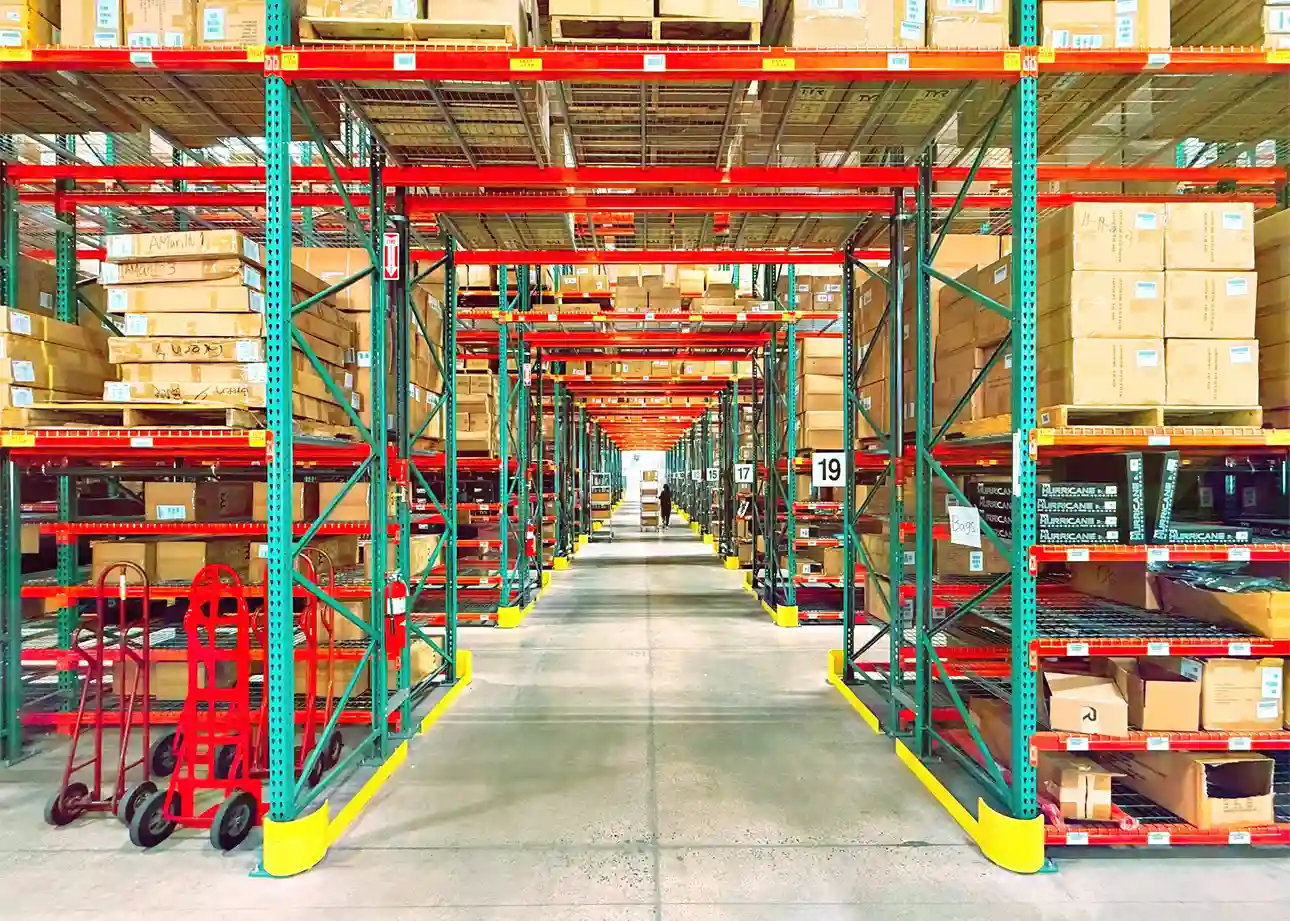
FMCG is defined by throughput. The average supermarket carries 10,000–50,000 SKUs, top hypermarkets carry up to 120,000, perishable categories turn over in 3–7 days, and a single distributor or large retailer places orders against the manufacturer continuously. For the commercial platform, this means catalog operations, pricing resolution, availability checks, and order processing have to run at a cadence and volume that other B2B sectors never approach. Platforms that batch catalog updates overnight, or that buckle under promotional peak load, convert velocity from an advantage into a liability—every lag shows up as a stockout, a spoiled shipment, or an order that never closes.

Trade promotion and pricing complexity

Pricing is where FMCG’s commercial complexity becomes most visible. A single account can carry several pricing and promotional logics in parallel: everyday list price, off-invoice and on-invoice discounts, scan-back and bill-back deals, volume rebates, listing and slotting fees, co-op and retail-media commitments, and channel-specific D2C pricing. Each mechanic carries its own accrual, its own settlement timing, its own audit trail. Trade spend is one of the largest lines on the FMCG P&L, and McKinsey identifies trade promotion optimization as one of the highest-value digital use cases precisely because so much of it leaks through manual, spreadsheet-driven processes today.

[VISUAL TO PRODUCE — Pic. A single account, seven pricing and promotional logics.]

Platforms that handle this well represent the channel- and account-specific commercial logic natively in the domain model rather than running spreadsheets alongside the commerce system. Native rebate management and CPQ for FMCG sellers become the architectural answer to representing this logic without forcing sales operations to reconcile several pricing systems by hand at period-end.

Route-to-market fragmentation

For decades the manufacturer worked through long, intermediated supply chains that masked the platform problem: as long as the distributor owned the customer relationship, the manufacturer could keep its commercial systems narrow and slow. That equilibrium is breaking. The manufacturer now has to serve modern-trade chains, the long tail of traditional trade, distributors, D2C, marketplaces, and quick commerce at the same time—each with a different ordering behavior, a different economics, and a different data signature. In emerging markets the scale of the long tail is staggering: McKinsey counts more than 13 million small grocers across India, China, Indonesia, and the Philippines, with India alone hosting 6.6 million. Digitizing that channel is now a primary commercial frontier.

Thin margins and the cost-to-serve

Unlike high-margin regulated sectors, FMCG runs on thin margins and high volume, so platform economics behave differently. Every fraction of a margin point matters, the cost to serve a fragmented base is rising, and the platform’s efficiency at volume is a direct P&L lever rather than a back-office concern. A platform that is expensive to run per transaction, or that requires manual intervention on a meaningful share of orders, erodes margin in a way that compounds across millions of transactions.

Peak-load and promotional cycles as a dual signal

Peak-load and promotional cycles are the most distinctive timing feature of FMCG platform decisions, and they behave in two directions at once.

  1. Read one way, they are a transformation trigger. Every peak season the platform strains, every new promotional mechanic earns its own workaround, every new channel adds integration debt. Past a certain threshold, the cost of doing nothing—lost orders at peak, trade-spend leakage, channels the business cannot launch—exceeds the cost of replatforming onto an architecture designed for volume and channel multiplication. The accumulating drag is what converts an FMCG commercial leader from skeptic to active buyer.
  2. Read the other way, the same cycles are a counter-signal. An active peak season or major promotional period closes the change window for a quarter or longer. No one replatforms the order engine in the run-up to the holiday quarter. Companies inside those windows defer transformation—not because they don’t need it, but because the change cannot be made cleanly.

[VISUAL TO PRODUCE — Pic. Peak-load and promotional cycles as a dual signal.]

Reading both signals at once is what separates FMCG commercial leaders who replatform successfully from those who stall. The choice is rarely about transformation itself. It comes down to timing the move to fall between peaks rather than across them.

Treat velocity, trade-spend density, and channel fragmentation as the defining features of any commercial platform built for FMCG at scale, and the rest of the transformation agenda—traditional-trade reach, D2C, marketplace, retail media, international markets—moves from theoretical to operational.

The next section turns to the channels themselves, where FMCG’s most consequential commercial decisions for the rest of the decade will be made.

Plan multi-market, multi-channel expansion: read the route-to-market expansion playbook

FMCG Digital Route to Market: The Commercial Frontier

Route to market is where structural economics meets commercial reality, and where FMCG’s most consequential platform decisions for the rest of the decade will be made. Direct channels, traditional-trade ordering apps, marketplaces, and quick commerce are pulling the manufacturer’s platform into a customer-facing role it was never designed for—at a velocity and channel breadth sharper than they have ever been.

Direct and B2B digital FMCG commerce

The clearest commercial story in FMCG route to market is the rise of manufacturer-direct B2B ordering platforms. AB InBev’s BEES platform is the reference case: as of the end of 2025 it was live in 29 markets, with 72% of company revenue captured through B2B digital platforms, generating $52.5 billion in gross merchandise value for the year across more than 6 million customers. The platform began as a small prototype and scaled into one of the largest B2B commerce ecosystems in the world—replacing the rep-visit ordering model with self-service ordering that small retailers use before they open, after they close, or during a lull in the day.

The pattern is consistent across the industry. Modern-trade buyers and traditional-trade owners alike want self-service ordering, real-time visibility into account status, credit and payment in the same flow, and automated reconciliation against complex pricing terms. The gains come less from the storefront surface and more from the integration depth underneath, where ordering, inventory, payment, promotions, and analytics converge.

The harder question for manufacturers is what to build, where, and through whom. A standalone D2C site that does not connect to the transactional B2B system creates two sources of truth and a guaranteed reconciliation problem. A unified platform that tries to serve modern trade, traditional trade, distributors, and consumers through a single model needs the channel modeling, pricing logic, and catalog flexibility to do all of them well—which is where platform architecture starts to matter more than feature catalogs.

Traditional-trade digitization

The long tail of small, independent retailers is FMCG’s largest and least-digitized channel, and it is being reshaped fast. Platforms like Alibaba’s Ling Shou Tong, Udaan in India, and Warung Pintar and GrabKios in Indonesia are connecting fragmented kiosk and kirana networks to centralized supply platforms, aggregating orders, lowering cost-to-serve, and bringing transparency to a channel that was invisible to manufacturers a decade ago. AB InBev’s BEES Marketplace—which lets retailers buy third-party products alongside the manufacturer’s own brands—reached $3.5 billion in GMV, up 61% year over year, showing how a direct traditional-trade channel becomes a monetization engine once the platform is in place.

The commercial platform’s job here is reach without friction. The retailer onboards in minutes, orders in a familiar mobile flow, and the manufacturer captures first-party data on a channel it previously saw only through the distributor. Platforms that handle this well make onboarding and ordering trivially simple for a non-technical shop owner while wiring the order straight into the same pricing, promotions, and order management backbone that serves modern trade.

Marketplaces, D2C, and quick commerce

The channel mix keeps multiplying. D2C lets the manufacturer own the consumer relationship and the data; marketplace models let it extend assortment and monetize third-party supply; quick commerce compresses the delivery window to minutes and rewrites the demand signal. Online grocery in the US reached around 19% share at peak in late 2025, and the retail-media layer that rides on top of these channels has become a major margin contributor in its own right.

Each new channel multiplies the demands on the commercial platform, carries its own economics, and compounds over time as old channels keep running alongside new ones. They each fail in similar ways when the underlying platform was designed for a narrower, intermediated commercial model.

The growth-enabler frame

All of these patterns—direct B2B portals, traditional-trade apps, marketplaces, D2C, quick commerce—share a structural problem.

  • They multiply the demands on the commercial platform.
  • They each carry their own pricing and promotional logic.
  • They each compound over time as new channels are added and old channels are kept running.
  • And they each fail in similar ways when the underlying platform was designed for a narrower, intermediated model.

The argument that closes this section is the one the rest of the article defends. Velocity-and-channel-by-design platforms—those that treat throughput, channel breadth, and promotional logic as foundational rather than as a customization tier—are the ones that unlock channel expansion. Channels that look impossible on a monolithic legacy suite become reachable on an architecture that isolates each commercial domain and lets it evolve at its own pace.

Composable commerce is the pattern that makes this work. A composable platform lets an FMCG manufacturer launch a traditional-trade ordering app, extend the B2B catalog to a new country, or add a marketplace model without rebuilding the entire stack—catalog, pricing, order, and integration domains each evolving independently, with change scoped to whatever actually changed.

The same pattern runs at scale across adjacent sectors with their own channel-multiplication problems: Heineken’s multi-country digital route to market, Bosch Home Comfort’s loyalty platform spanning more than fifty brand-country combinations, OMNIA Partners’ cooperative purchasing marketplace serving more than eleven thousand agencies. The architectural pattern they share is exactly what FMCG’s channel expansion problem requires.

Download the consumer goods commerce guide for a practical view of these channel dynamics

Manufacturing and Supply Chain in Consumer Goods 4.0

Manufacturing and supply-chain transformation is the part of FMCG’s digital story told most often in trade press. For commercial leaders, the manufacturing side matters mainly as context: the pace at which it transforms changes launch cadence, the structure of supply, and the demands those launches place on the commercial platform.

The pattern is now well established. McKinsey estimates that by 2030 roughly 30 to 35% of current activities across consumer functions could be automated, with the manufacturing function uniquely exposed at around 40% given how many of its activities are repetitive and non-customer-facing. AI-driven demand forecasting is already reshaping production planning—Unilever’s weather-based forecasting for temperature-sensitive categories is a widely cited example of tuning production weeks ahead of demand.

For commercial platforms, manufacturing and supply-chain modernization has two practical consequences.

  • The first is launch cadence: as production and forecasting become more flexible, manufacturers commit to faster, more targeted launches—including niche and premium SKUs aimed at narrower channels.
  • The second is supply integration: digital supply systems generate the availability, batch, and forecast data that commercial systems now need in real time to keep promises to fragmented customers. Supply data flows to commerce systems continuously rather than as end-of-cycle reports.

The argument here is that FMCG manufacturing has converged toward a recognizable industrial pattern, with velocity economics as the main variable. Many of these dynamics parallel adjacent sectors—see industrial digital transformation for a fuller treatment.

Innovation Acceleration: AI-led Product Development

Product innovation is the area where AI’s impact on FMCG has been most visible. For commercial leaders, the discovery models themselves matter less than what they do to the commercial pipeline. A faster, more targeted, more premium-heavy pipeline means more frequent launches, more narrowly defined consumer segments, more diverse channel structures, and more concurrent market introductions. Each of those changes loads cost and complexity onto the commercial platform that has to support them.

McKinsey reports that digitally enabled innovation lets CPG companies bring new products to market 50% faster, at a third lower cost, with double the return on investment. One beverage player used generative AI to compress new-product introduction time by 60%; food companies are using AI to automate formulation discovery and cut development cycles in half. Each is a different point on the same curve: AI is moving innovation activity that used to take months into shorter cycles with smaller teams.

The commercial consequences are second-order but real.

  • More launches per year means more compressed go-to-market cycles, with less time to build channel infrastructure between launches.
  • More premium and niche SKUs means more reliance on specialized channels, each with its own pricing and promotional overhead.
  • More targeted consumer segments means more segmentation work and more direct, data-rich engagement with the end consumer.
  • More parallel market introductions means more concurrent country-specific commercial work running through the same infrastructure.

AI’s acceleration of innovation is no longer the contested point. What remains contested is whether the commercial platform underneath the launch machine can absorb the resulting pipeline density without breaking under it.

Common Challenges in FMCG Digital Transformation

The standard list of FMCG digital transformation challenges—cultural resistance, high costs, channel complexity, legacy IT—is true but unhelpful. Every digital transformation in every industry runs into those things. The harder question is what kind of platform pain a given FMCG commercial enterprise actually has. In practice, four typologies cover most cases. Each compounds inside FMCG’s velocity-and-fragmentation frame in ways other verticals do not experience. And each tends to dominate in a single organization rather than spreading evenly—naming the right one is most of the diagnostic work.

1. Scale & Velocity Ceiling

The first and most acute constraint in FMCG is the rate and volume at which the commercial platform can absorb transactions and catalog change. The symptoms are recognizable: peak-load failures during promotional or seasonal spikes, order-processing lag, catalog updates that run overnight in batches rather than in real time, SKU onboarding measured in weeks, and availability data that is stale by the time the order is placed.

The textbook example sits at a multi-billion-dollar food manufacturer where the order engine slows to a crawl every peak season and a meaningful share of orders require manual intervention to clear. Demand is not the bottleneck. The commercial platform is—it cannot process the volume, resolve the pricing, and update availability fast enough to keep promises to a fragmented customer base.

👉 For platforms in this state, replatforming risk is the lesser problem. Standing still through the next peak is the bigger one.

2. Promotional / Operational Complexity Constraint

The second constraint shows up when trade-promotion mechanics, account-specific pricing, contract management, and channel logic have grown beyond what the commercial platform can model natively. The visible symptoms are spreadsheet-driven workflows where there should be system workflows—trade-spend accruals reconciled in Excel at period-end, off-invoice and on-invoice deals tracked in shared drives, rebate settlements done by hand, and a margin picture that no one trusts until the quarter closes.

A common scenario: a manufacturer maintaining several parallel promotional logics—scan-backs for one retailer, volume rebates for another, listing fees and co-op commitments across the rest—in spreadsheets, because the commercial platform cannot represent them natively. The cost is visible at period-end as trade-spend leakage. The risk is visible the next time finance asks for a clean price-by-account-by-transaction trail.

3. Channel / Business Model Constraint

The third constraint surfaces when the platform was never designed for the channels the business now wants to enter.

  • D2C pilots stall in IT review.
  • Traditional-trade ordering apps require a parallel system because the main platform cannot model the long-tail customer or the mobile ordering flow.
  • Marketplace and third-party models get ruled out at scoping because the platform was not built to host them.
  • Quick-commerce and retail-media integrations run as separate applications, with customer and order data drifting out of sync.

A manufacturer running a separate “informational” D2C site alongside its transactional B2B system is the everyday version of this. Two systems, two source-of-truth claims, two reconciliation efforts, and one platform that cannot host the unified experience customers are asking for.

4. Architectural Lock-in

The fourth constraint is structural and the most expensive to escape. Architectural lock-in in FMCG is severe because the platform’s pace of change cannot keep up with the pace of route-to-market change.

  • Integration projects get deferred because new channels require large, coupled releases.
  • Vendor-imposed restrictions on customization extend the lock-in further.
  • Multi-market and data-residency requirements block cloud-architecture decisions that would be obvious in any other context.

The FMCG version: a manufacturer locked into a closed monolithic commerce suite where adding a single new channel or market triggers a multi-quarter release conversation before the work itself can even begin. License cost stops being the relevant number. What matters is the cost of every change for the next decade—and the cost of every channel the business cannot launch at all because the architecture rules it out.

Fig. Four constraint categories that hold FMCG commercial platforms back.

Most FMCG commercial leaders do not face all four at once. They face one dominant constraint that drives the rest. In FMCG the dominant constraint is usually the Scale & Velocity Ceiling or the Channel/Business Model constraint—both amplified by transaction volume, both compounded by years of customization debt, both increasingly difficult to address through incremental investment in the existing platform. Naming the dominant constraint is the recognition moment. Most of the platform decision follows from there.

Working through the diagnostic? The consumer goods commerce guide walks through how channel and constraint dynamics play out across the vertical

What to Look for in an FMCG DT Platform

Six platform criteria matter more than the rest in FMCG commercial decisions. They determine whether the platform can serve the channels and markets the business needs over the next decade, and whether the cost of running it stays manageable as velocity and channel breadth keep rising. Each criterion below is framed as a question for the buyer rather than a feature claim from a vendor. The order matters: criteria (a) through (e) are necessary conditions, and criterion (f) is the defining one.

(a) Velocity-and-scale-by-design architecture

Does the platform handle SKU volume, order throughput, peak load, and catalog churn as native capabilities, or does it degrade under the conditions FMCG runs in every day? The answer is visible in how the platform behaves at peak, how fast catalog and pricing changes propagate, and whether availability is resolved in real time. Platforms that treat scale as something to tune after the fact carry compounding cost and risk on every peak.

(b) Channel breadth and route-to-market orchestration

Can the platform serve modern trade, traditional-trade ordering apps, distributor integration, D2C, marketplace, and quick commerce from a single commercial model? A platform that needs a separate system for each channel guarantees reconciliation problems and a fractured customer view. One that models all of them natively starts every new-channel launch far ahead.

(c) Native trade-promotion and pricing modeling

Can the platform represent the full range of FMCG pricing and promotional mechanics—off-invoice, scan-back, volume rebate, listing fee, co-op, account-specific terms—in the domain model rather than in spreadsheets alongside it? Modular, API-first architectures let this logic live as isolated, governable extensions. The question is whether trade spend is a managed system capability or a manual reconciliation burden.

(d) TCO across transaction volume and channel multiplication

Initial license cost is the smallest line item in an FMCG platform decision over a five-to-ten year horizon. The numbers that dominate are cost-per-transaction at volume, trade-spend leakage, customization debt absorption, and the time-to-market cost of new channels. A platform with low license cost and high cost-to-operate at FMCG volume is more expensive in service than a platform with the inverse profile.

(e) Integration breadth for the FMCG stack

FMCG runs on a heavy integration estate—ERP (often SAP), OMS, WMS, distributor systems, CDP, retail-media and marketplace connectors, and supply-and-forecast feeds. A platform that exchanges data cleanly across this estate, with reference implementations already in place, starts the work shorter than one that treats every integration as a custom project. Multi-market and data-residency configuration belong in the same architectural model rather than in a forked codebase.

(f) Channel velocity (incremental composability)

Channel velocity is the criterion that subsumes most of the rest. The defining cost line in FMCG platform decisions is how fast a new channel, market, or pricing mechanic can be launched—and platforms split sharply on it. Platforms that require large, coupled releases to add a channel measure new-channel launch in quarters. Platforms that isolate domains and support change scoped to what actually changed—catalog one cycle, a traditional-trade app the next, a marketplace after that—compress the same launch to weeks.

[VISUAL TO PRODUCE — Pic. The channel-launch velocity gap.]

Over a five-year horizon, the gap is measured in captured GMV, trade efficiency, and whether the business can support new channels at all. Big-bang replatforming has stopped being the only available model. Insisting on it now signals architectural rigidity rather than commercial discipline.

Fig. Platform evaluation criteria for FMCG digital commerce.

FMCG platform decisions tend to fall into one of two patterns.

  1. The first treats the decision as a sourcing exercise—comparing license costs, feature inventories, and reference customers.
  2. The second treats it as an architectural commitment—choosing the operating model the commercial function will live with for the next decade. The second pattern is the one the criteria above support. The next section walks through a recent example of the second pattern—what an architectural commitment looks like when it works.

Case in Point: Digital FMCG Route to Market in Action

Consider a global consumer-goods manufacturer with operations across dozens of countries and a portfolio spanning several categories. The company runs modern trade, traditional trade, distributor, D2C, and marketplace models in parallel, layered across thousands of accounts and millions of end customers. Each market carries its own channel mix. Each category carries its own pricing and promotional logic. Leadership commissioned a re-architecture to unify the digital commerce experience across all of it.

The problem the team faced was structural rather than tactical. A monolithic commerce suite serving that many channels, geographies, and promotional models would strain at every peak and compound integration debt with every new market. One of the company’s largest growth bets—a direct traditional-trade ordering app for the long tail of small retailers—was a workflow the existing infrastructure could not support without bolting on a second system.

The architectural decision was to move to composable commerce. The team picked the hardest use case first—the traditional-trade direct channel—on the theory that proving the platform could handle the most fragmented, highest-volume case would validate it for everything else. The composable model let them isolate the onboarding flow, the mobile ordering experience, the account-specific pricing, and the order record as separate components, each evolving independently and each changed only when the component itself changed. The rest of the stack stayed undisturbed while the channel scaled.

What that company discovered, others in the sector are discovering. The pattern works because velocity economics and commercial architecture stop fighting each other. Once the platform is structured for incremental change, every new market, channel, and category stops triggering a wholesale rebuild. AB InBev’s BEES is the public proof at scale: a direct platform that grew from prototype to $52.5 billion in GMV across 29 markets and more than 6 million customers, with a third-party marketplace layer monetizing the same route to market.

The composable pattern is not specific to any single vendor. Virto Commerce runs it at scale in FMCG and adjacent sectors with similar channel complexity—multi-country digital route to market at Heineken, multi-country loyalty and commerce at Bosch Home Comfort, and multi-country B2B at Cadillac & KW Parts, where the platform supports four million products across thirty countries with full multi-currency operation—and the architectural mechanics translate directly to FMCG’s channel-multiplication problem.

Final Thoughts on Digital Transformation in FMCG Companies

The argument running through the sections above is one an FMCG commercial leader can act on: name the dominant constraint holding the current platform back, evaluate any replacement against the six criteria with channel velocity weighted heaviest, and choose an architectural path that handles incremental change across channels and markets.

  • For a practical playbook on B2B commerce for consumer-goods leaders, download our consumer goods commerce guide.
  • For commerce and technology leaders managing multi-market, multi-channel expansion, our route-to-market expansion playbook walks through the architectural choices that determine whether the next channel launches in weeks or quarters.
  • Or talk to our team to map your specific channel and route-to-market roadmap.

In 2026, FMCG digital transformation has stopped being a catch-up exercise against other industries and become an architectural commitment—to a commercial platform where velocity and channel breadth live at the foundation rather than wrapped around the outside.

You might also like...